




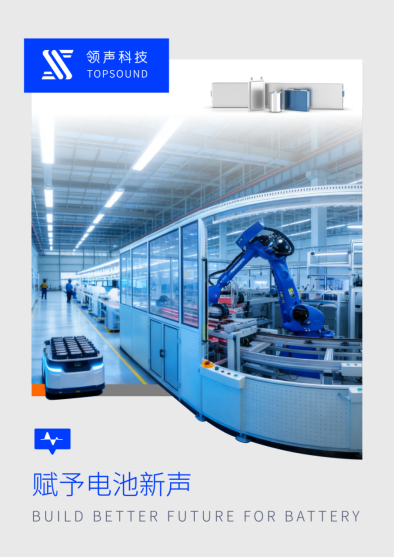

Is the essence of advanced manufacturing really just manufacturing?
In many people’s minds, the core of advanced manufacturing of battery cells is based on the precision manufacturing of electrode sheets. It achieves a high degree of consistency through micron-level precision control throughout the entire process, and uses AI smart manufacturing and collaborative innovation of materials, structures, and processes to continuously find optimal solutions among energy density, safety, cycle life, and cost.
In the past decade or so, the entire lithium battery industry has continued to evolve around automation levels and production capacity scale.
From semi-automatic production lines to fully automated production lines, from high-speed manufacturing of a dozen cells per minute to hundreds of cells per minute, from large cylindrical 4680 to dry electrodes, electrode sheet die-cutting and other new processes, the industry is always pursuing higher production efficiency and lower manufacturing costs.
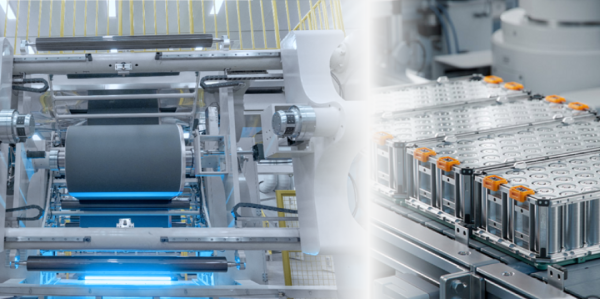
At the same time, manufacturing accuracy continues to break through:
Ingredients accuracy has entered the 0.2% era;
Rolling thickness control is within 2μm;
The injection volume deviation is reduced to ±5‰;
The lamination positioning accuracy reaches sub-millimeter level.
Throughout the battery cell manufacturing process, the pursuit of consistency has reached the micron scale.
However, an often overlooked fact is:
Consistency is not "made" but "measured".
Without high-precision detection capabilities, we cannot know where the thickness deviation of each electrode sheet comes from, cannot find defects hidden in the welding interface, and cannot confirm whether the internal structure and interface state of the battery cell are truly uniform.
Manufacturing capacity determines the lower limit of products, while testing capacity determines the upper limit of manufacturing.
The upgrade of advanced manufacturing is essentially an upgrade of detection capabilities. Only when detection accuracy exceeds manufacturing accuracy can process optimization and yield improvement truly have a basis for continuous iteration.

If you can't see it, you can't control it well.
Quality guru Joseph M. Juran expressed his core views:
Without a standard there is no logical basis for making a decision or taking action. (Without standardized quantitative benchmarks, there is no basis for scientific decision-making and improvement)
For advanced lithium battery manufacturing, measurement and testing is the only carrier for the implementation of all process standards. Most manufacturing companies underestimate the value of MI and only regard it as a supporting link for poor sorting. In fact, MI is the core base for building process standards and achieving refined control. Without reliable measurement and testing capabilities, manufacturing control will lose its judgment ruler:
Can complete cell processing and assembly;
However, it is impossible to establish unified and reproducible process judgment standards;
Inability to distinguish random fluctuations from inherent workmanship defects;
Unable to establish a stable yield control system;
It is impossible to realize the stable implementation of new generation high-precision technology in batches.
It can be seen that MI is not only a quality control tool, but also the core engine of standardized manufacturing upgrades:
Standard Builder
Establish a quantitative process benchmark for the entire process
Variance Cutter
Identify and eliminate process variable deviations
Profit Booster
Relying on stable management and control to continuously reduce quality losses

Today’s semiconductors may be the tomorrow of lithium batteries
Looking back at the development of the semiconductor industry over the past half century or so, it is essentially a history of continuous improvement of “observable capabilities.”
From the evolution of micron-level processes to today's 2nm GAA architecture, from EUV lithography to High-NA EUV, to the popularization of chiplets, 3D stacking and hybrid bonding technologies, the industry is always racing against those "invisible defects".
When the device structure moves from two dimensions to three dimensions, it is no longer enough to just see the surface clearly.
How to penetrate complex structures, accurately identify deep defects, and use the detection results to reverse process optimization has become an important issue in the post-Moore era.
Today's lithium battery industry is at a similar stage of development to some extent.
Compared with the rapid improvement of manufacturing capabilities, the industry is still making up for a key course:
How to truly see every aspect of battery manufacturing.
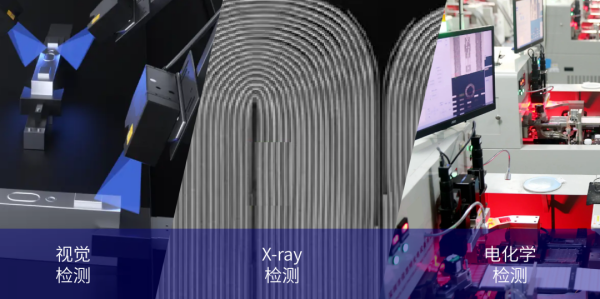
From thickness fluctuations in electrode sheet coating to hidden dangers of virtual welding at the welding interface;
From slight deviations in lamination alignment to misalignment of electrode sheets inside the cell;
The quality control of each process essentially relies on detection technology to provide accurate feedback.

What "eyes" have been established for lithium battery manufacturing?
After years of development, the lithium battery industry has formed a relatively complete testing system.
Pole manufacturing stage: AOI machine vision
In the coating, rolling and slitting processes, AOI visual inspection serves as the first line of quality defense.
With the help of 8K and 16K line scan cameras and multi-spectral light sources, online detection of 5 μm-level defects can be achieved, and problems such as missed coatings, foil exposure, cracks, wrinkles, edge burrs, etc. can be identified in real time.
Cell assembly stage: X-ray and welding inspection
After entering the winding, lamination and assembly processes, X-rays become an important means of observing the internal structure.
It is mainly used to detect problems such as electrode sheet alignment deviation, abnormal winding quality, internal structure misalignment, etc.
Finished product verification stage: CT and electrochemical testing
In the finished product stage, X-ray CT and electrochemical impedance spectroscopy (EIS) further verify the quality of the cells from both structural and electrochemical dimensions. CT is responsible for observing the three-dimensional internal structure; EIS is used to analyze the electrochemical behavior characteristics of the cell.
At this point, the lithium battery industry already has the ability to detect most solid structures.

Two pieces of the puzzle are still missing in the lithium battery testing system
Although detection technology continues to advance, there are still obvious "hierarchical faults" in the current lithium battery detection system.
The existing visual, X-ray and traditional ultrasonic testing mainly focus on: metal current collector, electrode sheet structure, welding interface, cell geometry, etc.
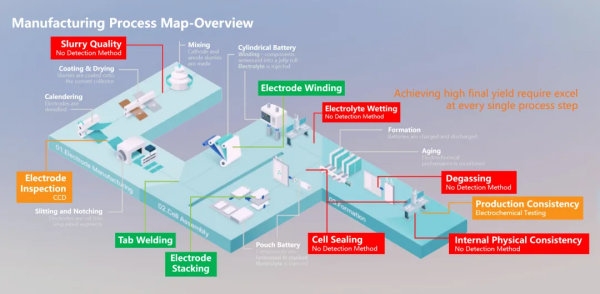
However, the industry still lacks mature mass production online testing methods for the two key dimensions that determine battery performance and safety:
The first piece of the puzzle: electrolyte wetting state
Whether the electrolyte is fully and evenly wetted directly determines the transmission efficiency of lithium ions and the quality of the interface reaction.
However, at present, the industry still mainly relies on empirical parameters and waiting time to make indirect judgments.
"Whether the wetting is complete" is still a "waiting" in many cases.
The second piece of the puzzle: analysis of the dynamic evolution inside the battery cell
What is the quality of the SEI film formed during the chemical formation process? Is lithium plating occurring in the negative electrode? Is there an abnormal evolution of the internal interface?
These factors directly impact battery life, safety and consistency.
However, at present, relevant testing is still mainly based on in-situ laboratory research, and a large-scale, online production closed loop has not yet been formed.
In other words, the lithium battery industry has been able to better observe the "solid", but it is still difficult to observe the "liquid" and "evolution process" inside the cell in real time.
This is precisely the most important breakthrough direction of next-generation detection technology.
Ultrasonic testing is filling this gap
To truly "see every production link clearly," the industry needs new detection capabilities, and ultrasonic technology is becoming an important bridge connecting the manufacturing process and the internal state of the battery cells.
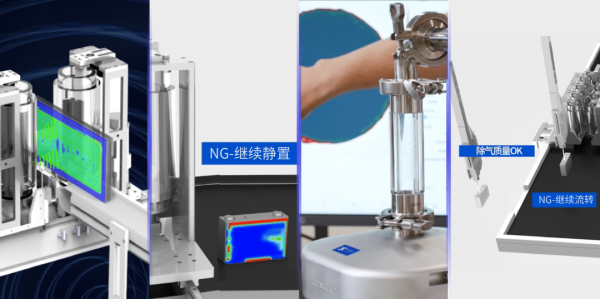
Based on the differences in the propagation characteristics of ultrasonic waves at different media interfaces, Topsound Technology has constructed an ultrasonic testing solution for production line applications, enabling rapid and non-destructive observation of the internal state of the cell.
<Can be detected in liquid, semi-solid and fully solid states>
Visualization of electrolyte wetting status
Through ultrasonic scanning, the distribution of electrolyte inside the cell can be directly displayed, and the uniformity of wetting and the location of local dry areas can be identified. Issues that used to rely on experience and time judgment began to have data and visual basis.
Online evaluation of degassing effect
Ultrasound can identify the location, size and distribution of bubbles inside the cell, providing quantitative data support for optimization of liquid injection, resting and packaging processes.
Lossless perception of internal state
Through acoustic coupling analysis, the internal interface status, structural changes and potential defects of the cell at each stage can be sensed without disassembling the cell.
Provides new detection dimensions for quality grading, process optimization and full life cycle management.

From "problem discovery" to "drive optimization"
The real value of ultrasonic inspection is not just in finding defects.
More importantly, it allows the originally invisible state inside the battery cell to be observable at the mass production level and online for the first time.
This means that in the past, we relied on random inspections to infer overall quality, but in the future, we will be able to grasp the complete status information of each battery cell. In the past, we relied on experience to adjust the process; in the future, we can optimize parameters based on real data.
As massive amounts of ultrasound data are continuously accumulated and analyzed, the causal relationships in the manufacturing process will gradually be quantified.
For example:
How changes in injection volume affect wetting uniformity;
Whether shortening the standing time will produce local dry areas;
How adjustment of the formation curve will change the interface state;
Which process parameters are most likely to cause quality fluctuations.
These questions can all be answered through data.
Inspection has been upgraded from a quality control tool to a data entry for manufacturing optimization.

From "testing again" to "testing to promote manufacturing"
The development of the semiconductor industry has proven that when the detection accuracy is high enough and the detection coverage is wide enough, the data will eventually reversely drive the evolution of manufacturing itself.
Manufacturing capabilities determine whether a product can be produced; while testing capabilities determine how high the manufacturing level can be improved.
Today's lithium battery industry is also facing the same turning point.
From offline random inspection to online full inspection; from result verification to process control; from passive quality inspection of "testing again" to active optimization of "testing to promote manufacturing".
The competition in advanced manufacturing in the future will not only be about who can do it faster and cheaper, but also who can see deeper, more accurately, and more comprehensively.
Testing capabilities are becoming a new infrastructure for advanced lithium battery manufacturing.
Follow Topsound Technology on WeChat for more industry insights
 The Global Leading Expert of Battery Quality and Safety