




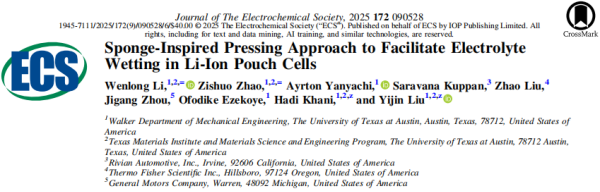
Affiliations: Walker Department of Mechanical Engineering & Materials Institute and Materials Science and Engineering Major, University of Texas at Austin, Rivian Automotive Company, Thermo Fisher Scientific, General Motors Corporation
There is an extremely unfair time difference in the lithium-ion battery manufacturing process. On one side is injection: it can be done in a few minutes; on the other side there is wetting: it often takes 24–48 hours to complete, or even longer.
If you imagine the cell as a "high-density sponge" with a complex structure and tortuous channels, then the liquid injection is just pouring water on the surface. What really determines the performance is whether the liquid can penetrate into the deepest part and establish a continuous and stable ion path in the separator and porous electrode.
Insufficient wetting will also cause a series of chain side reactions - local ion transmission is blocked, internal resistance increases, SEI film formation is uneven, etc., thereby accelerating battery performance degradation and is an industry-recognized key bottleneck affecting production capacity. There is no shortage of ideas for “accelerating wetting” in the industry: increasing temperature, increasing vacuum, optimizing material structure, etc.
Take temperature rise as an example: the wetting process after temperature rise is still very slow - in this article, it still takes about 30 hours to complete the wetting at 45°C. So the question arises: How can we reduce the wetting from the "day" level to the "hour" level by only performing a "simple and replicable" action on the basis of the existing material structure?
Based on the principle of "sponge water absorption", a research team from the University of Texas at Austin proposed the use of a "pulse pressurization" process to improve the wetting efficiency of the electrolyte into the electrode pores, and directly characterized the dynamic wetting process through real-time monitoring technology, ultrasonic detection and high-frequency impedance. The relevant research results "Sponge-Inspired Pressing Approach to Facilitate Electrolyte Wetting in Li-Ion Pouch Cells" were published in the famous journal "Journal of The Electrochemical Society".
The battery ultrasonic scanning system used in this study was provided by Wuxi Topsound Technology Co., Ltd.
This system provides real-time, in-situ, non-destructive and visual key technical support for the electrolyte wetting process, changing the wetting state from "invisible" to "measurable".
① Turn "wetting" from a black box into a visual process: Ultrasonic transmission images directly display the changes in the wetting area inside the battery over time, avoiding the chance of just "resting for enough time".
② The pulse pressurization condition is mild and efficient: the author chose a mild pressure of about 10 kPa (the battery thickness changed only 86 μm). After 30 minutes in the high-frequency mode (0.5 s pressurization/0.5 s relaxation), the unwetted area was greatly reduced, and it was close to full wetting in 60 minutes; the corresponding HFR value also dropped and stabilized within 1 hour.
③ Fast and non-destructive, the cell performance is completely reliable: after pulse compression treatment, the 2 Ah pouch cell maintains a capacity of about 2 Ah and an average Coulombic efficiency of 98.4% after 200 cycles at 1C; it is close to the performance of the control group (48 h wetting at room temperature) with an average Coulombic efficiency of 98.1%.
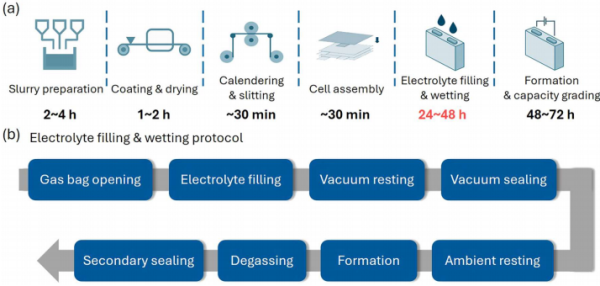
Figure 1. (a) Lithium-ion battery manufacturing process and corresponding step length; (b) Liquid injection and wetting processes in pouch cell production
Figure 1 shows that in the lithium battery manufacturing process, steps such as slurry preparation, coating, rolling, and assembly generally take minutes to hours, but soaking takes 24-48 hours or even longer, so it is recognized as a "capacity bottleneck."In fact, the liquid injection action itself is very fast. What really takes time is the process of the electrolyte entering the diaphragm and porous electrodes and establishing a continuous ion path.
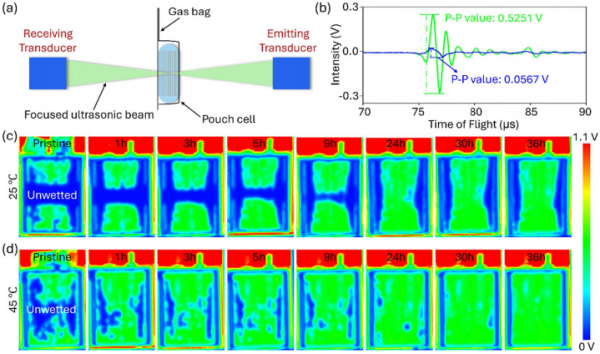
Figure 2. Using ultrasound to monitor the degree of electrolyte wetting in pouch batteries (a) Schematic diagram of ultrasonic transmission; (b) Transmission waveforms of unwetted (blue) and wetted (green) areas; Ultrasonic transmission images of different wetting levels at (c) room temperature (25 ℃) and (d) 45 ℃.
To shorten the wetting time, the researchers explored the effect of increasing temperature on the wetting rate. In Figure 2, the author uses ultrasonic transmission imaging to monitor the wetting status inside the battery. Ultrasonic transmission imaging is based on the difference in acoustic impedance: the solid-gas interface (not wetted) has a greater signal attenuation and appears blue in the image; the solid-liquid interface (wetted) has a smaller attenuation and appears green, thereby realizing the visualization of the spatial distribution of wetting.
The results show that within the first 3 hours, raising the temperature to 45°C can significantly accelerate the wetting, but it still takes about 30 hours to approach complete wetting. Therefore, reducing the viscosity by raising the temperature can only improve the flow of unobstructed pores, but it is difficult to solve the problem of electrolyte wetting in deep tortuous pores. To achieve hour-level wetting, external force driving is still needed.
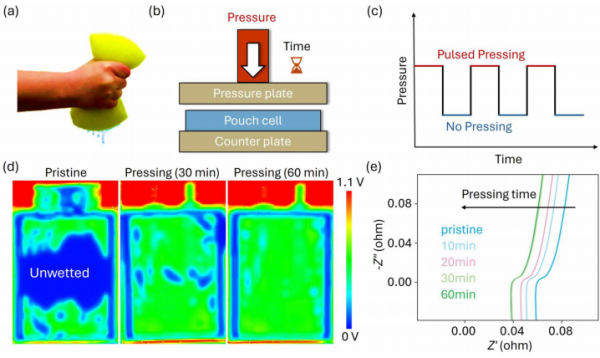
Figure 3. (a) Schematic diagram of sponge-like absorption; (b) Schematic diagram of a pulse pressurization system that applies intermittent pressure during electrolyte wetting; (c) Pressure-time variation curve of the pulse pressurization strategy; (d) Ultrasonic transmission images of pouch batteries in different time periods; (e) High-frequency resistance (HFR) variation trend of electrochemical impedance spectroscopy (EIS).
Inspired by the "sponge water absorption" mechanism, this study proposes a high-frequency pulse pressurization process to accelerate the wetting of electrolyte into porous electrodes. The specific operation is to apply a periodic mild pressure of about 10 kPa to the cell (0.5 s pressurization/0.5 s relaxation). Under this condition, the thickness of the cell changes only about 1.37%, taking into account the wetting efficiency and structural stability.
Ultrasound imaging and electrochemical impedance spectroscopy simultaneously verified the effectiveness of this process: under high-frequency pulses, the unwetted area decreased significantly within 30 minutes, and was nearly completely wetted after 60 minutes; at the same time, the HFR resistance, which characterizes the ion transmission path, dropped rapidly and stabilized within 1 hour, confirming that the electrolyte had fully penetrated into the pores. In contrast, although low-frequency pulse (5 minutes of compression/5 minutes of relaxation) has certain improvements, its efficiency is significantly lower, and complete wetting cannot be achieved after 5 hours. Therefore, high-frequency pulse compression has significant advantages in achieving rapid and uniform wetting.
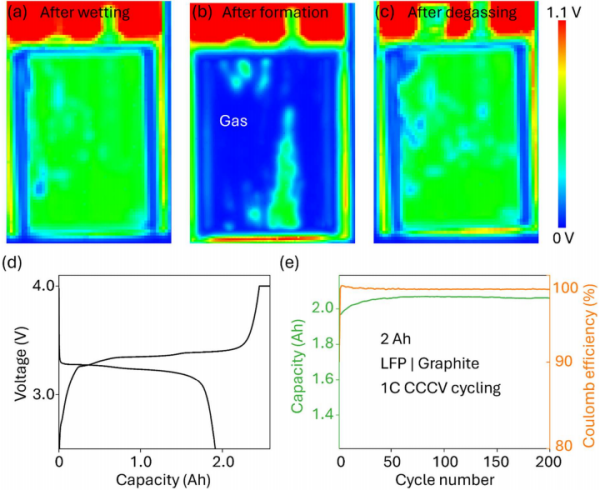
Figure 4. (a)-(c) show the ultrasonic transmission images of the pouch cell treated by pulse pressure at different stages; (d) the charge-discharge capacity and voltage curves of the pouch cell treated by pulse pressure during the first formation period; (e) the cycle performance test results of the 2 Ah LFP/C pouch cell treated by pulse pressure.
Will high-frequency pulses destroy the internal structure of the battery and affect the cycle performance? To this end, the researchers conducted electrochemical tests using 2 Ah LFP/C pouch cells.
The long cycle results prove that pulse pressurization did not damage the battery structure, and the cycle performance is basically consistent with that of the 48 h standing wetting control group. This key comparison shows that the pulse pressurization strategy shortens the wetting time from "tens of hours" to "1 hour" while maintaining the excellent electrochemical performance and cycle stability of the battery, achieving a win-win situation in efficiency and performance.
This article focuses on the pain points of "long wetting time and difficult to ensure uniformity" in lithium battery manufacturing, proposes and verifies the simple and replicable process path of "pulse pressurization", and builds a closed loop of evidence through "ultrasonic visualization + HFR quantification": under the conditions of about 10 kPa mild pressure and high-frequency pulse (0.5s pressurization/0.5s relaxation), the wetting is completed in 60 minutes, and the HFR also decreases and stabilizes within 1 hour; while it takes 40 to stand at room temperature without pressurization.h and above can approach the same level.
From a process perspective, the greatest value of this work is not only "faster", but also pushes the wetting from "time based on experience" to the engineering level of "adjustable parameters and judgment":
① Frequency/number of pressurizations has been proven to be the core factor that determines efficiency. Although low frequency has been improved, the time scale is not available;
② Ultrasound and HFR provide a potential "release basis" for wetting, providing help in upgrading the wetting process to an indicator-driven closed-loop process in the future.
In this process, Topsound Technology's battery ultrasonics technology provides effective technical and product support at different stages.
Topsound Technology's high-resolution ultrasonic imaging capabilities can perform real-time, in-situ, visual characterization of the electrolyte wetting process inside the cell, clearly presenting the wetting path, spatial distribution and time evolution rules, providing direct evidence for understanding the wetting mechanism and comparing different process strategies. Based on these visual results, the production line process parameters can be further deduced and optimized, including key variables such as wetting duration, pressurization frequency, process rhythm and process flow mode.
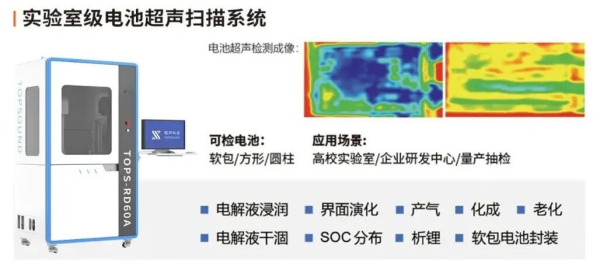
Topsound Technology is equipped with high-speed ultrasonic scanning and full-scale inspection capabilities for production lines. It can realize rapid online judgment of the cell wetting status without disrupting the rhythm, provide real-time and objective quality feedback for the wetting process, and support the production line to maintain process consistency and stability while improving efficiency.
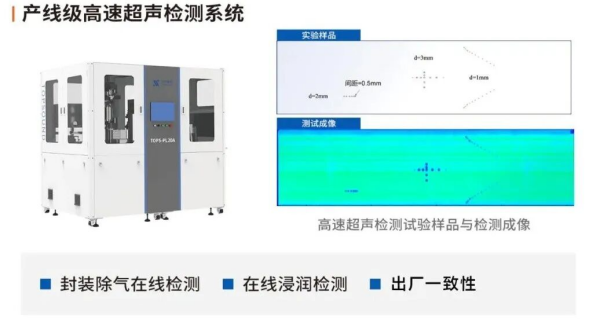
Topsound Technology is committed to taking independent innovation as its long-term drive, continuing to provide new and effective testing methods for the battery industry, and building quality and safety solutions covering the entire battery life cycle.
Sponge-Inspired Pressing Approach to Facilitate Electrolyte Wetting in Li-Ion Pouch Cells
https://doi.org/10.1149/1945-7111/ae04a6
Follow Topsound Technology on WeChat for more industry insights
 The Global Leading Expert of Battery Quality and Safety