






Affiliations: Department of Mechanical Engineering, Imperial College London, Department of Chemical Engineering, Imperial College London, School of Future Technology, South China University of Technology, Department of Chemical Engineering, Loughborough University
The low mixing quality of the slurry in the slurry mixing stage is an important factor in the high scrap rate in battery manufacturing, which hinders the efficient and sustainable production of batteries. Current characterization methods for slurries are relatively backward, and the offline characterization of slurry rheology is slow and difficult to meet the needs of quality control or process optimization. At the same time, current detection methods are also difficult to detect the dispersion within the slurry. Ultrasound, as a promising online, non-destructive characterization tool, can meet this detection need.
Yifei Yang and others from Imperial College London summarize decades of development and application of ultrasonic inspection technology and identify challenges unique to this technology for high-concentration, non-Newtonian battery slurries. Key ultrasound and slurry interaction mechanisms (including attenuation, wave speed, scattering, and guided wave propagation) are discussed, as well as how ultrasonic detection can be used to characterize microstructural features (such as particle dispersion and agglomeration) and macroscopic rheological properties (such as viscosity and viscoelasticity). To fully exploit the critical but limited information obtained through ultrasound, the authors propose a hybrid framework that combines ultrasound data with other offline data through physically informed machine learning to achieve accurate and comprehensive performance estimation.
Highlight 1: Directly addressing the pain points of the industry. Aiming at the core issues of low efficiency and high scrap rate of battery slurry mixing, the potential of ultrasonic online monitoring technology as a fundamental solution is systematically reviewed for the first time.
Highlight 2: Analyzing special challenges. In-depth evaluation of the unique application difficulties and interaction mechanisms of ultrasonic technology in the complex system of high-concentration, non-Newtonian battery slurry, and indicating key research directions.
Highlight 3: Creating an integration framework. An innovative framework of "physical information machine learning" is proposed, integrating ultrasonic and offline data, aiming to achieve accurate and comprehensive online estimation and process optimization of slurry properties.
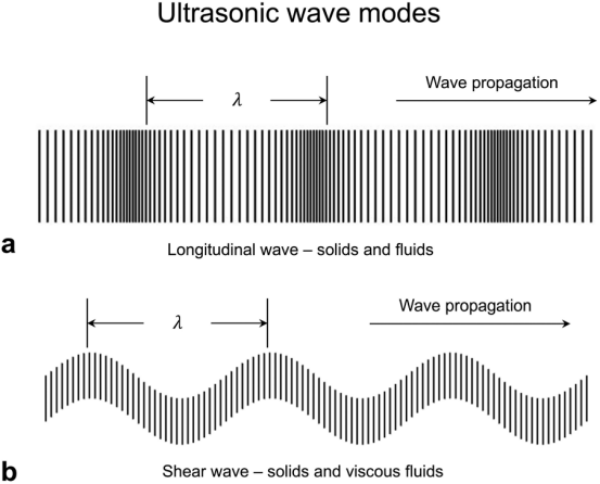
Figure 1: Classification of ultrasonic wave types: (a) compression wave (longitudinal wave); (b) shear wave.
Ultrasound refers to sound waves with a frequency higher than 20 kHz, and the megahertz (MHz) frequency band is usually used in material characterization. It is mainly divided into two modes (as shown in Figure 1(a) and (b)):
Longitudinal wave (compression wave): The vibration direction of the medium particles is parallel to the propagation direction of the wave.
Transverse wave (shear wave): The vibration direction of the medium particles is perpendicular to the direction of wave propagation.
Longitudinal waves can propagate in solids and fluids, while transverse waves mainly propagate in solids and can only penetrate into high-viscosity fluids in trace amounts (the penetration depth is in the micron range, depending on the viscosity of the fluid). Ultrasonic waves will interact with components in the slurry and produce detectable physical responses, including:
Attenuation (decrease in wave amplitude with propagation distance)
Backscatter (noise-like signal produced by suspended particles scattering part of the sound wave back to the transmitting probe)
Among them, the changes in wave speed and attenuation can be mathematically described by harmonic equations. The interaction between ultrasound and slurry depends on the contrast between its wavelength (frequency) and the size of the particles in the slurry. Therefore, the accurate characterization of slurry properties relies on the precise measurement of these measurable physical quantities (especially their variation with frequency in a wide frequency band).
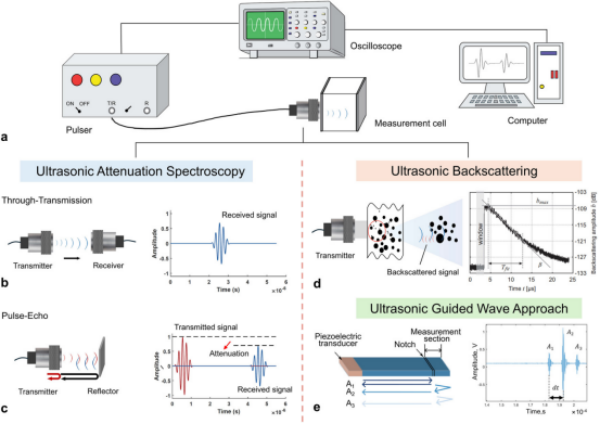
Figure 2: Schematic diagram of ultrasonic experimental measurement configuration.(a) Experimental setup; (b) Ultrasonic attenuation spectrum measurement using transmission method and (c) reflection method to arrange probes; (d) Ultrasonic backscattering measurement; (e) Ultrasonic guided wave method for macroscopic performance measurement.
A typical ultrasonic testing device is shown in Figure 2(a). It transmits and receives signals through the probe to achieve millisecond-level real-time detection in millimeter-level samples. The wave velocity and attenuation of slurry are often measured by transmission method and reflection method (Figure 2(b)(c)). Because the battery slurry has dispersion characteristics, frequency domain analysis is required; the attenuation is determined by comparing the ultrasonic attenuation spectrum (UAS) with the reference medium. The backscattered configuration (Figure 2(d)) is sensitive to particle size and concentration, but multiple scattering makes interpretation difficult. Guided waves (Figure 2(e)) are commonly used to measure viscosity and viscoelasticity and are sensitive to slurry boundary properties.

Figure 3: The main interaction mechanisms between ultrasonic waves and suspended particles in thick slurry (a) medium replacement; (b) density difference; (c) multipolar resonance: (d) compressibility difference; (e) thermal difference.
When ultrasonic waves propagate in slurries, particles and fluids interact through a variety of physical mechanisms due to differences in physical properties such as density, compressibility, and thermal conductivity. As shown in the figure, it can be mainly summarized into the following five mechanisms:
Media replacement (Figure 3(a)): This is the most direct phenomenon, that is, the presence of solid particles changes the acoustic environment of the original pure fluid. For high-concentration battery slurries containing dense particles (such as NMC cathode materials, graphite anodes), medium replacement is the dominant factor leading to ultrasonic energy attenuation and wave speed changes.
Density difference (Figure 3(b)): The density difference between particles and fluids results in different inertias between the two. Under sound pressure oscillations, the particles resist accelerated motion, while the surrounding fluid exerts viscous resistance on them (i.e., viscous-inertial effect). This mechanism induces scattering and viscous energy dissipation, which is most significant in battery slurries with high solid content.
Multipolar resonance (Figure 3(c)): When the wavelength of the incident sound wave is equivalent to the size of the particle, the particle will undergo resonance oscillation, become a multipolar radiation source, and produce a sharp attenuation peak at the resonance frequency. Larger sized aggregates in battery slurries may exhibit resonant behavior in the commonly used ultrasonic frequency range (<20 MHz), so this mechanism can be used to monitor particle agglomeration on-line during the mixing process.
Differences in compressibility and thermal properties (Figure 3(d) and (e)): The difference in compressibility results from the difference in bulk modulus of particles and fluids, resulting in different degrees of deformation under sound pressure; differences in thermal properties may cause thermal diffusion and energy loss. However, since most battery active materials have low compressibility, particle sizes typically in the micron range, and high thermal conductivities, these two effects have relatively little impact on the overall acoustic response of the battery slurry.
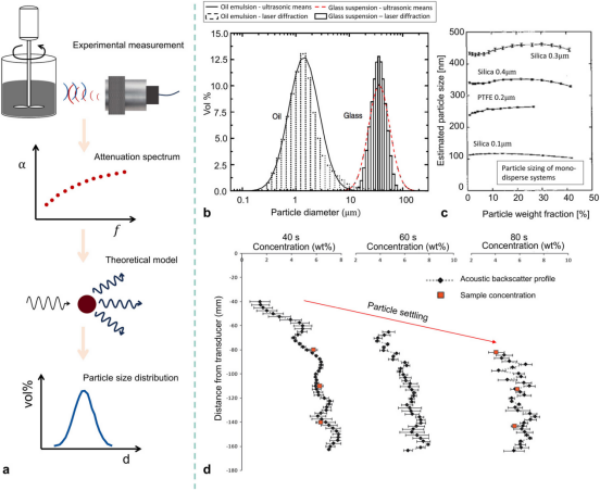
Figure 4: Inversion characterization of microstructure based on ultrasonic measurements.(a) Schematic diagram of the working principle of the inversion process; (b) Comparison of particle size distributions (PSDs) of water-in-oil emulsions and glass bead-water suspensions; (c) Comparison of particle sizes (d50) of monodisperse suspensions with different concentrations; (d) Concentration profile distributions of the flocculated glass bead dispersion system measured by the acoustic backscattering system (ABS) at 40 seconds, 60 seconds and 80 seconds during the settling process.
The ultrasonic detection system characterizes the solid content, particle size and uniformity of the suspension system through the inversion model. This method usually presupposes that the particles obey logarithmic normal distribution, and makes the model match the experimental data through fitting. The most commonly used one is the ultrasonic attenuation spectrum (Figure 4(a)). Studies have shown that for oil-in-water emulsions or low-concentration glass beads, the ultrasonic attenuation method is highly consistent with the particle size distribution measured by a commercial laser diffractometer (Figure 4(b)). In monodisperse silica and PTFE suspensions, the attenuation analysis based on the core-shell model also verified its accuracy (Figure 4(c)). In addition, attenuation spectroscopy has been successfully used to monitor changes in slurry concentration during the mixing process in real time (Fig. 4(d)). Backscattering techniques are equally effective, especially in high-concentration systems, and are consistent with optical and attenuation methods. They can be used to estimate particle size distribution, density, and track sedimentation processes and concentration gradients through signal intensity. Homogeneity and dispersion can be viewed as an extension of the size distribution: agglomeration leads to an increase in the equivalent particle size. Ultrasonic resonance can sensitively reflect the homogenization process of nanoparticles, while backscattering is suitable for studying the flocculation phenomenon and dynamic uniformity of complex systems (Figure 4(d)).
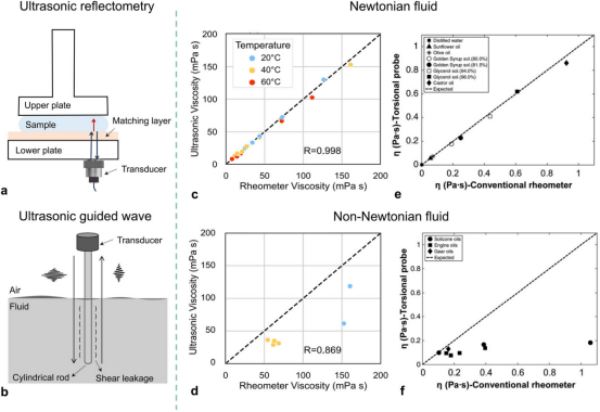
Figure 5: Fluid viscosity measurement method based on ultrasonic technology.(a) Schematic diagram of the shear wave ultrasonic reflection method; (b) Schematic diagram of the torsional mode ultrasonic guided wave measurement device; (c) (d) Comparison of the viscosity measurement results of Newtonian lubricants and non-Newtonian fluids by the ultrasonic reflection method and conventional rheometer respectively; (e) (f) Comparison of the viscosity measurement results of Newtonian fluids and non-Newtonian fluids by the conventional rheometer and the torsional waveguide probe.
Ultrasonic technology can also be used to determine the rheological properties of battery slurries in situ, mainly through the following two methods:
Shear wave reflection method (Figure 5(a)): Based on viscous coupling at the solid-liquid interface. When a shear wave is incident from the solid side, the energy transferred into the fluid causes the amplitude attenuation and phase shift of the reflected wave, the changes of which are related to the viscosity of the fluid.
Guided wave viscosity measurement method (Figure 5(b)): Using a waveguide (such as an immersion probe) to insert into the slurry, the propagating shear or torsional wave leaks energy to the surrounding fluid. The degree of energy attenuation is quantitatively related to the viscosity. Compared with the reflection method, guided wave technology is more flexible in design and has stronger spatial sampling capabilities.
It should be pointed out that the above methods are mostly established for Newtonian fluids. For non-Newtonian battery slurries, the viscosity values measured by ultrasonic are usually lower than the traditional rheometer results (Figure 5(c)-(f)). This may originate from the response of ultrasonic waves to extremely high shear rates, or may be related to viscoelastic relaxation. Currently, the equivalent shear rate in ultrasonic measurements is still unclear, and how to relate dynamic viscosity to steady-state shear viscosity remains a key challenge.

Figure 6: Battery slurry online monitoring method based on ultrasonic monitoring and physical information neural network prediction: (a) Schematic diagram of physical information neural network architecture; (b) Schematic diagram of closed-loop optimization control of slurry mixing based on this method.
The accuracy of PINN relies on reliable offline calibration: by preparing samples of different formulations, using ultrasound and offline characterization to build a data set containing microstructure-rheology-ultrasonic response, providing paired input-targets for PINN, allowing it to learn slurry properties from ultrasonic signals, while embedding physical constraints (such as ultrasonic propagation equations) through composite loss functions. Training can be pre-trained by generating synthetic data based on the physical model, and then fine-tuned with experimental data. As a proxy model, the trained PINN can analyze ultrasonic data in real time, quickly output the slurry state, microstructure and rheological properties, and make predictions robust and efficient. Models can use continuous data updates to build digital twins to achieve closed-loop optimization. The core advantage lies in the deep fusion of offline characterization information, making the online ultrasonic signal a real-time pointer of multi-dimensional slurry status.
The article points out that the microstructure and rheological behavior of the slurry directly determine its processing performance and final battery performance. Ultrasonic monitoring provides key support for closed-loop optimization of battery slurry mixing and related manufacturing processes.
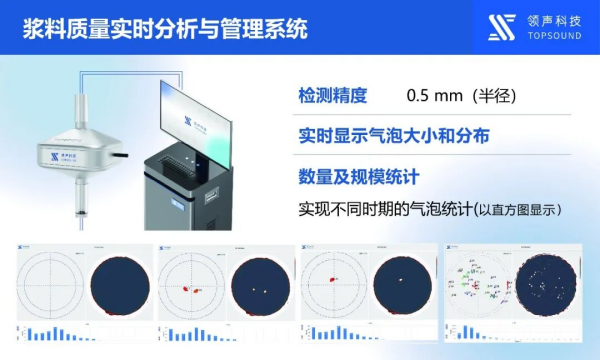
Topsound Technology has created a new production line-level ultrasonic solution - real-time slurry quality analysis and management system (TOPS-SLU). This system accurately makes up for the lack of detection methods for air bubbles and foreign matter in the pipeline during the pulping stage of the current production line. Through independently developed non-invasive ultrasonic sensing probes and advanced algorithm systems, it can provide system monitoring functions of detecting, imaging, analyzing, counting, and alarming foreign objects such as bubbles and agglomerates in the slurry, providing strong technical support for the quality control of the pulping process.
TOPS-SLU introduces a new monitoring dimension to the slurry process and fills the gap in production line testing. It has completed technical verification in the battery production lines of many leading companies at home and abroad, and its market recognition and industry influence continue to increase.
Includes:
1. Adaptable to full-viscosity slurries: For slurries of different concentrations, TOPS-SLU completed response verification in a production line. The results showed that the system is suitable for multi-viscosity systems and maintains excellent detection stability and applicability under different process conditions.
2. Stable bubble detection capability under complex slurry systems: In view of the opaque characteristics of slurry, TOPS-SLU completed pre- and post-deaeration verification of A/B formula slurries in a production line. The system effectively detected bubbles and accurately identified the number and particle size distribution of bubbles, providing a reliable basis for production line quality control.
3. Stable capture of small-sized foreign objects: The system can accurately respond to, identify and count foreign objects with a diameter of 0.4mm or more, and the size deviation is controlled within ±10%, covering the key size range of process concern, providing reliable pre-warning capabilities for the production line.
The system not only has scene applicability and a high degree of stability, but can also achieve continuous, real-time and accurate monitoring of foreign matter in the slurry, providing strong technical support for the quality control of the battery pulping process in the production line.
Topsound Technology not only realizes high-precision "color ultrasound" detection of the internal status of slurries and batteries, but also creates a comprehensive technical layout covering laboratory analysis and large-scale testing of production lines, and deploys non-destructive full inspection solutions in the key process links of wetting/degassing/factory consistency of the production line. As one of the first teams in the world to conduct battery acoustic characteristics research and non-destructive analysis, Topsound Technology has established its core competitiveness with its profound technological accumulation and has now obtained more than 140 domestic and foreign intellectual property rights.
In the future, Topsound Technology will continue to be committed to long-term drive of independent innovation, provide new and effective testing methods for the battery industry, build quality and safety solutions covering the entire battery life cycle, continue to improve product and service quality, expand market development space, and provide strong support for industrial transformation and upgrading and high-quality economic development.
Towards inline ultrasonic characterization of battery slurry mixing: opportunities, challenges, and perspectives
DOI: 10.1039/d5ee03563e
Follow Topsound Technology on WeChat for more industry insights
 The Global Leading Expert of Battery Quality and Safety